Enlarged prostate is a benign condition that affects men as they age.
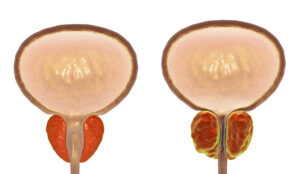
An enlarged prostate, also known as Benign Prostatic Hyperplasia (BPH) is a non-cancerous enlargement of the prostate. As men age, the prostate continues to slowly grow. Over time, this enlargement can cause prostate tissue to block the urethra which affects urination. Generally, men may notice BPH symptoms once they reach their 50s. However, not every man will experience symptoms associated with an enlarged prostate. For those who do, there are many treatment options available to remove prostate tissue blockage, and improve urine flow.
What are the symptoms of BPH, or an enlarged prostate?
The prostate surrounds the urethra just below the bladder. As the prostate grows, it can trigger symptoms that irritate or obstruct the bladder. Common symptoms of BPH include:
- Weak urine stream.
- Starting and stopping while urinating.
- Delay in stream when attempting to urinate.
- Frequency – Needing to go to the restroom several times during the day.
- Nocturia – The need to urinate several times during the night.
- Feeling like the bladder has not emptied after urination.
- Dribbling after urinating.
- Urinary retention – An inability to urinate. Retention is considered an emergency condition.
To assist providers in their diagnosis, the American Urological Association created the International Prostate Symptom Score (IPSS). This worksheet allows patients to review common BPH symptoms, and score themselves on how these symptoms may be affecting them. This worksheet also captures a Quality of Life score from patients. By completing this worksheet, and sharing it with their urologist, the provider is able to get an overview of what symptoms are affecting the patient, and the severity of symptoms. For your convenience, we are providing English and Spanish versions of the IPSS score sheet (courtesy of Boston Scientific).
IPSS-Score-Sheet-English-version
IPSS-Score-Sheet-Spanish-version
Enlarged prostate diagnosis
There are several methods that a urologist will use to help assess the severity of symptoms and make a diagnosis. They will also want to rule out other urologic conditions that can have similar symptoms. The following screening tools may be utilized during an evaluation:
- Complete medical history and review of existing medical conditions.
- Review of current medications.
- In-office physical exam.
- IPSS Score Sheet
- Digital rectal exam to evaluate the prostate.
- Urinalysis to screen for infections, blood, and/or bacteria.
- PSA blood test
- Post void residual – An ultrasound of the bladder to determine if there is urine left in the bladder after urinating.
- Uroflowmetry – This test will measure the flow of urine.
- UroCuff – A non-invasive diagnostic tool used by Urologists to evaluate bladder efficiency: bladder function, pressure and urine flow.
- Prostate ultrasound – Imaging used to evaluate the size and shape of the prostate gland.
- Urodynamics – In-office testing to measure how the bladder fills and empties. This is scheduled as a separate visit due to the length of this test.
- Cystoscopy – A scope that is fed through the penis to the bladder. This allows the urologist to visualize the condition of the bladder and the urethra.
Treatment options for an enlarged prostate
The appropriate treatment option will largely depend on the severity of symptoms and patient preference. Treatment options include:
- Watchful waiting – Watching the progression of the condition over time without immediate treatment.
- Medications.
- Minimally-invasive options such as Rezum or UroLift. These are generally performed in the office.
- Surgical options such as GreenLight Laser or TURP.
- Pulmonary Artery Embolization (PAE), new minimally invasive interventional radiology procedure.
Millions of men are affected by the symptoms on an enlarged prostate. Fortunately, there are many treatment options available to restore urine flow while addressing bothersome symptoms. If you are experiencing issues that could be linked to an enlarged prostate, contact Urology Austin to schedule an appointment.
Dr. Varun Sundaram presents a webinar on Benign Prostatic Hyperplasia (BPH or Enlarged Prostate). He discusses the condition, symptoms and treatment options including Aquablation Therapy. The presentation materials for this webinar were supplied by Procept BioRobotics, the manufacturer of the Aquablation system.
Dr. Michael McClelland, Urologist at Urology Austin, presents a webinar on Benign Prostatic Hyperplasia, also know as BPH or enlarged prostate. Dr. McClelland discusses the condition, symptoms and treatment options. He also discusses Rezum Water Vapor Therapy, an in-office, minimally invasive treatment option for BPH. This webinar was hosted by Boston Scientific.
Watch Dr. Michael McClelland Jr., Urologist at Urology Austin, being interviewed on KVUE TVs “Spotlight ATX” about Benign Prostatic Hyperplasia (BPH or enlarged prostate) and Rezum Water Vapor Therapy. The interview was co-sponsored by Boston Scientific.
Watch Dr. Jones’ webinar on Benign Prostatic Hyperplasia (BPH or enlarged prostate). During the webinar he discusses symptoms and treatment options, including minimally invasive procedures that can be done in the office.
Watch Dr. Varun Sundaram’s webinar on Benign Prostatic Hyperplasia (commonly known as BPH or enlarged prostate). Dr. Sundaram covers prostate health, and overview of BPH and the BPH treatment pathway including minimally invasive solutions. These solutions include Rezum Water Vapor Therapy and GreenLight Laser Therapy.
Related links