Enlarged prostate symptoms and diagnosis
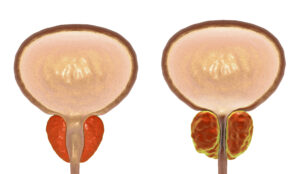
An enlarged prostate, also known as benign prostatic hyperplasia or BPH, is an enlargement of the prostate gland. This enlargement can cause several annoying symptoms, including difficulty in emptying the bladder. As men age, the prostate naturally enlarges, so a growing prostate doesn’t necessarily mean a man has BPH or that he will experience urinary symptoms. For those who do, the size of the prostate doesn’t always determine how severe symptoms might be. Therefore, the symptoms and diagnosis of an enlarged prostate is very individualized.
Symptoms and diagnosis of an enlarged prostate
Symptoms of BPH most often develop around the age of 50, although they can be experienced much earlier. Typical symptoms may include:
- A decrease in the force of stream (weak stream).
- A urine stream that starts and stops throughout the flow.
- A delay in starting the stream.
- Frequent urination during the day.
- A feeling that the bladder has not completely emptied.
- Waking up frequently at night to urinate (Nocturia).
- Dribbling urine at the end of the stream.
- An inability to urinate (urinary retention).
It’s important to understand that these symptoms are not part of the normal aging process. If left untreated, they may ultimately be harmful to the bladder or kidneys. For example, incomplete emptying could contribute to urinary tract infections, bladder stones, or urinary incontinence (leakage). It’s important to seek treatment early to help avoid the risk of developing complications or more permanent problems.
How is an enlarged prostrate diagnosed?
The first step in diagnosing BPH is to tell your doctor about your symptoms. Considering the many treatment options that are available, there is no need to suffer with this condition. Following are some basic in-office evaluation procedures:
- Complete medical history – your medical history should include all of the urinary symptoms that you are experiencing.
- Physical examination – this will include a digital rectal exam to evaluate the prostate.
- Urinalysis – a urine sample will be taken to check for the presence of bacteria, blood cells, or infection.
The following tools may also be utilized for further diagnosis:
- PSA Blood Test – PSA is a specific substance produced only by the cells of the prostate gland. Patients with BPH, Prostatitis (an inflammation of the prostate), and cancer can have higher than normal levels of PSA. If your PSA is higher than it should be, further evaluation will be warranted.
- Bladder Scan – This ultrasound testing tool is used to measure your post void residual (PVR) or the amount of urine that remains in the bladder after urination.
- Uroflowmetry – This test measures urine flow, which is often lower than normal for men with BPH.
- UroCuff – A non-invasive diagnostic tool used by Urologists to evaluate bladder efficiency: bladder function, pressure and urine flow.
- Prostate Ultrasound – This technique takes a picture of the prostate using sound waves. The doctor uses a special ultrasound probe that is placed in the rectum to evaluate the size and shape of the prostate.
- Urodynamics – This test measures the pressure in your bladder during filling and urination. The goal is to determine whether urinary problems are due to weakening of the bladder muscle or blockage from an enlarged prostate.
- Cystoscopy – This procedure is generally performed in the office using a scope that is inserted through the urethra. This allows your doctor to view the length of the prostate and to evaluate any abnormalities of the urinary channel.
Once it has been determined that BPH is the cause of the symptoms, and that no other problems exist, there are several different types of therapy that can be used to treat the symptoms.